

Every video marketing statistics 2026 roundup starts with the same number: 91% of businesses use video. That stat has barely moved in three years. I read five reports this month and kept finding a different story underneath, starting with an 11-point ROI drop that almost nobody is talking about.
TL;DR
- Video marketing ROI perception dropped from 93% to 82% in one year, the largest single-year decline in Wyzowl’s 12-year dataset.
- Only 40% of teams plan to increase video budgets in 2026, down from 57% in 2023. Nearly half are keeping budgets flat.
- AI adoption in video production jumped from 51% to 63% in one year (Wyzowl), but Wistia’s platform data shows adoption plateaued at 38%.
- LinkedIn overtook YouTube as the top B2B video channel. 81% of teams now cite LinkedIn as their primary platform.
- Short-form video is the highest-ROI content format for 49% of marketers, and the top three ROI-driving formats are all video-based.
- Consumer demand is stable: 84% want more video from brands, and 85% say a video has convinced them to buy. Execution is the bottleneck, not demand.
What Everyone Leaves Out on Headline Stats
Three numbers appear in every video marketing statistics 2026 post. 91% of businesses use video as a marketing tool. 93% of video marketers consider it an important part of their strategy. 82% say video gives them a good ROI.
The first two have been stable for years. The 91% figure bounced back after a slight dip in 2025. The 93% strategy number is down a point from last year and up three from 2024.
Single-point movements in a 266-person survey are noise, not signal. These numbers have hit their ceiling.
The third number is the one that changed. And that is where the real 2026 story starts.
The ROI Drop No One Is Discussing
In 2025, 93% of video marketers said video gave them a good return on investment. In 2026, the number is 82%. An 11-point decline in a single year.
In 12 years of Wyzowl’s survey data, this is the largest single-year ROI drop on record.
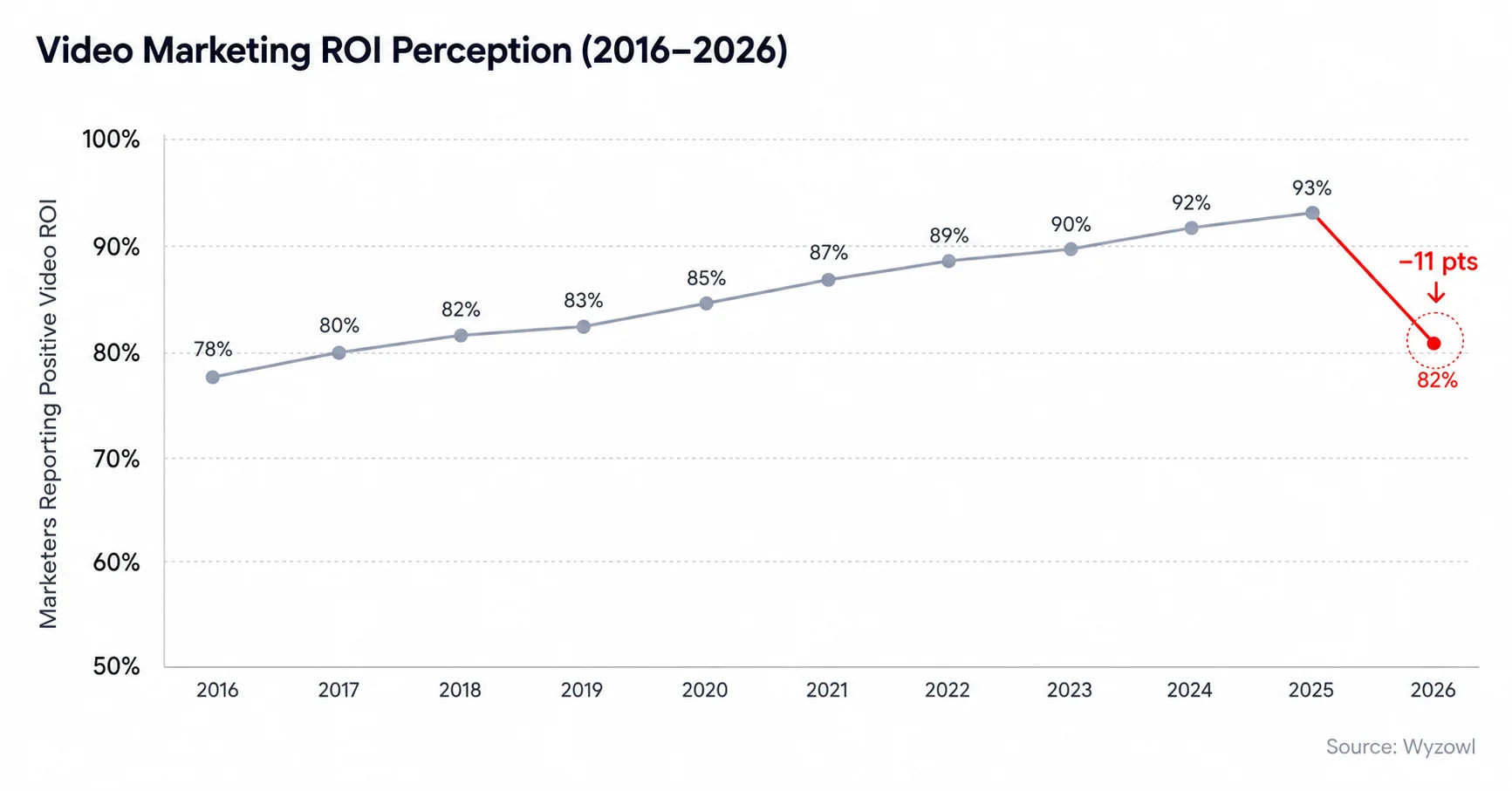
The adoption rate held steady. The strategy confidence held steady. But the people doing video marketing are significantly less confident it is working. That disconnect is worth examining.
Three possible explanations. First, measurement is maturing. More teams now track video through conversion metrics and CRM integrations instead of view counts. When you measure better, you sometimes find less than you assumed.
Second, content saturation is real. When 91% of businesses produce video, standing out requires more than showing up. The same tactic that worked in 2022 produces diminishing returns in a more crowded feed.
Third, AI-assisted production has lowered the quality floor. More video exists, but more of it is forgettable.
Four out of five marketers still report positive ROI. But the direction matters more than the level. This is the first real signal of a mature market where returns are harder to capture.
Budgets Are Flattening While Output Keeps Climbing
Wistia’s 2026 State of Video Report surveyed over 900 professionals and analyzed 13 million videos on their platform. The budget picture: more output demanded, same money available.
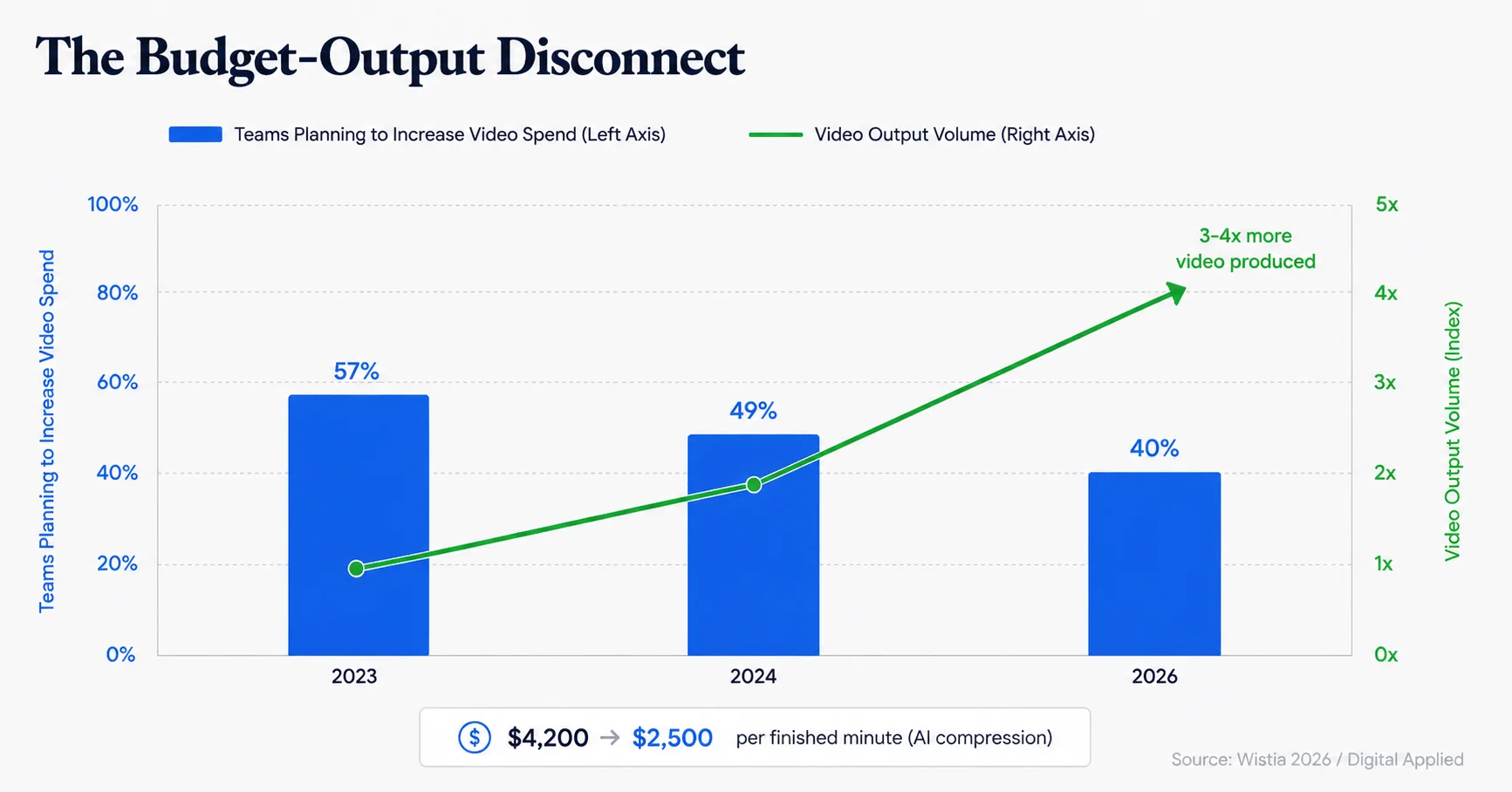
40% of teams plan to increase video spend this year. That sounds healthy until you compare it to 2023, when 57% planned to increase. Almost half of all teams are keeping budgets flat. Nearly 40% of companies spent under $5,000 on production last year.
But output is not flattening. Companies with over 50 employees ramped up video production in 2025. Total plays grew across all company sizes.
The math only works because production costs are dropping. AI tools have compressed the median cost per finished minute from roughly $4,200 to $2,500, a 40% reduction.
This creates a paradox. The savings go straight back into volume, not the budget. Teams produce 3 to 4 times more video with the same spend. More competition for the same audience attention. Which circles back to the ROI drop.
AI in Video Production: The Gap Between the Narrative and the Data
The industry narrative says AI has transformed video production. The data is more complicated.
Wyzowl reports 63% of video marketers have used AI tools to help create or edit marketing videos, up from 51% in 2025. A 12-point jump in a single year. Sounds like a surge.But Wistia’s platform data tells a different story. Their report puts AI adoption at 38%, down from 41% the prior year. Not a surge. A plateau.
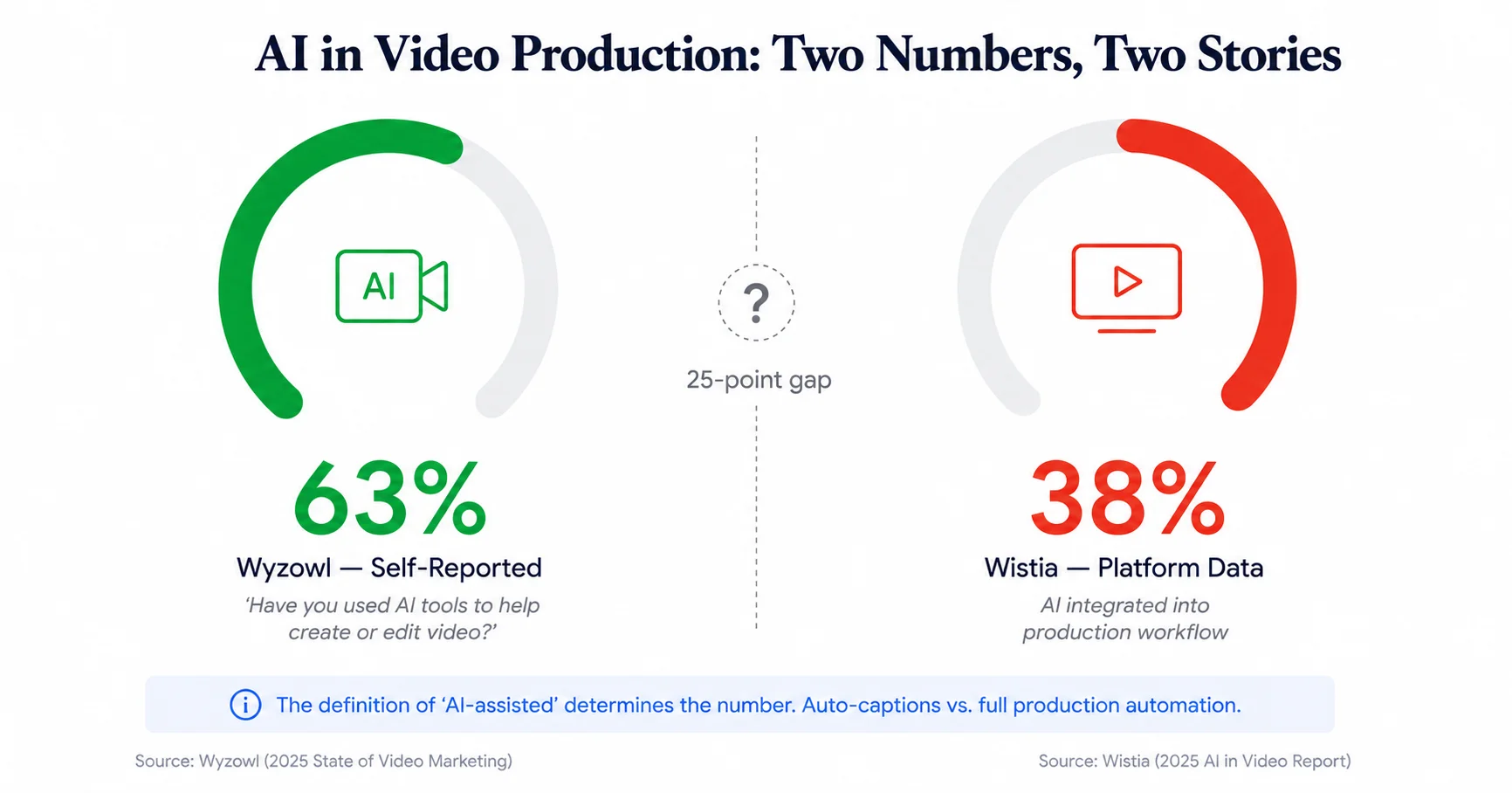
The gap is a definition problem. Wyzowl asks if you have “used AI tools to help create or edit” videos. That includes auto-captions, transcript generation, and audio cleanup. If you have ever used a captioning tool built into your editing software, you count.
Wistia measures AI integration into the production workflow. A higher bar.
The real adoption picture: most teams use AI for low-risk, practical tasks. Captions and transcripts are the most common use case. Scripting and ideation come second. Full AI-generated video is still rare. The fastest-growing AI applications in the Wistia report are accessibility-related, not creative automation.
This matters for how you read the “75% of marketing videos are AI-assisted” stat that some roundups cite. When auto-captions count as AI assistance, that number is almost meaningless as a signal of creative transformation.
Where the Money Goes: Platforms and Formats
The platform map shifted in 2026, and the biggest change is at the top of the B2B list.
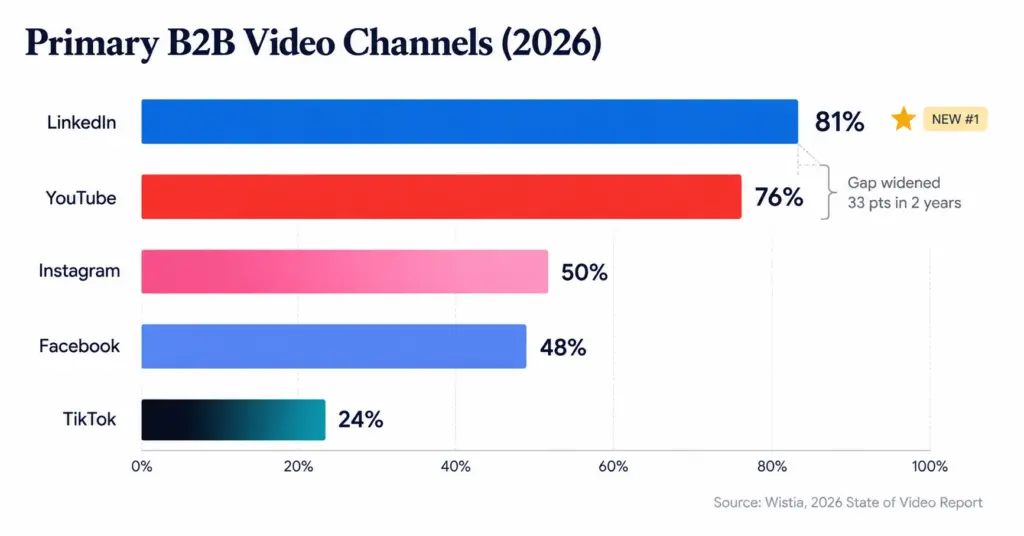
LinkedIn overtook YouTube as the primary B2B video channel. 81% of teams now cite LinkedIn as their top platform for sharing video, compared to 76% for YouTube.
This gap widened by 33 percentage points over two years. LinkedIn is also the top platform where teams pay to promote video content.
YouTube still dominates consumer reach. 90% of video marketers use it, and it remains the most widely used platform overall. But the split is now clear: YouTube for reach, LinkedIn for B2B conversion.
The HubSpot 2026 State of Marketing Report settled the format ROI debate. The top three content formats by marketer-reported ROI are all video: short-form at 49%, long-form at 29%, and live-streaming at 25%. No other content type cracks the top three.
Short-form video (under 60 seconds) generates roughly 2.5 times more engagement per impression than any other content type.
But there is a catch. Wistia’s data shows videos under a minute average a 52% engagement rate. Viewers watch about half. Longer videos score lower on percentage engagement but generate more total watch time.
The format choice depends on the goal. Short-form for social reach and awareness. Long-form for on-site education, lead generation, and SEO value.
What the Consumer Side of the Data Says
Marketer perception data is self-reported. Consumer behavior data is not, it’s harder to argue with.
96% of people have watched an explainer video to learn about a product or service. 85% say a video convinced them to buy. 80% downloaded or purchased an app after watching a demo.
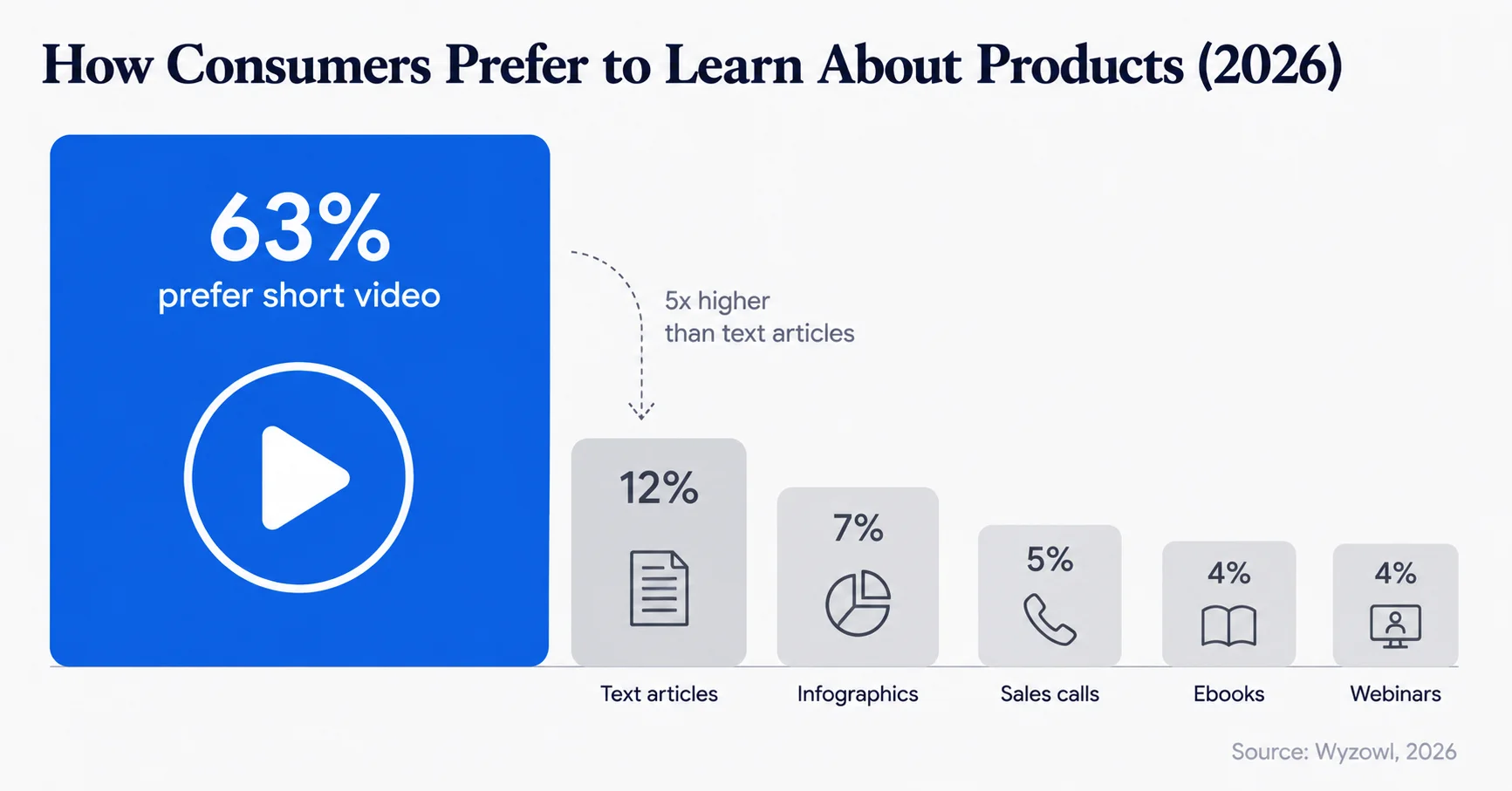
When asked how they prefer to learn about a product, 63% choose a short video. Five times higher than text-based articles at 12%. Sixteen times higher than ebooks at 4%.
84% of consumers say they want to see more videos from brands in 2026. This number has stayed within an 8-point range for eight consecutive years. No growth, no decline. Stable demand.
89% say video quality affects their trust in a brand. Down from 91% last year, up from 87% in 2024. Quality awareness is a constant, not a trend.
The consumer side of the data is clear. Audience demand is not the problem. People want video, trust it, and buy from it. The constraint sits on the production side: flat budgets, more volume, and too little measurement.
Video Marketing Statistics 2026 vs 2025: What Shifted
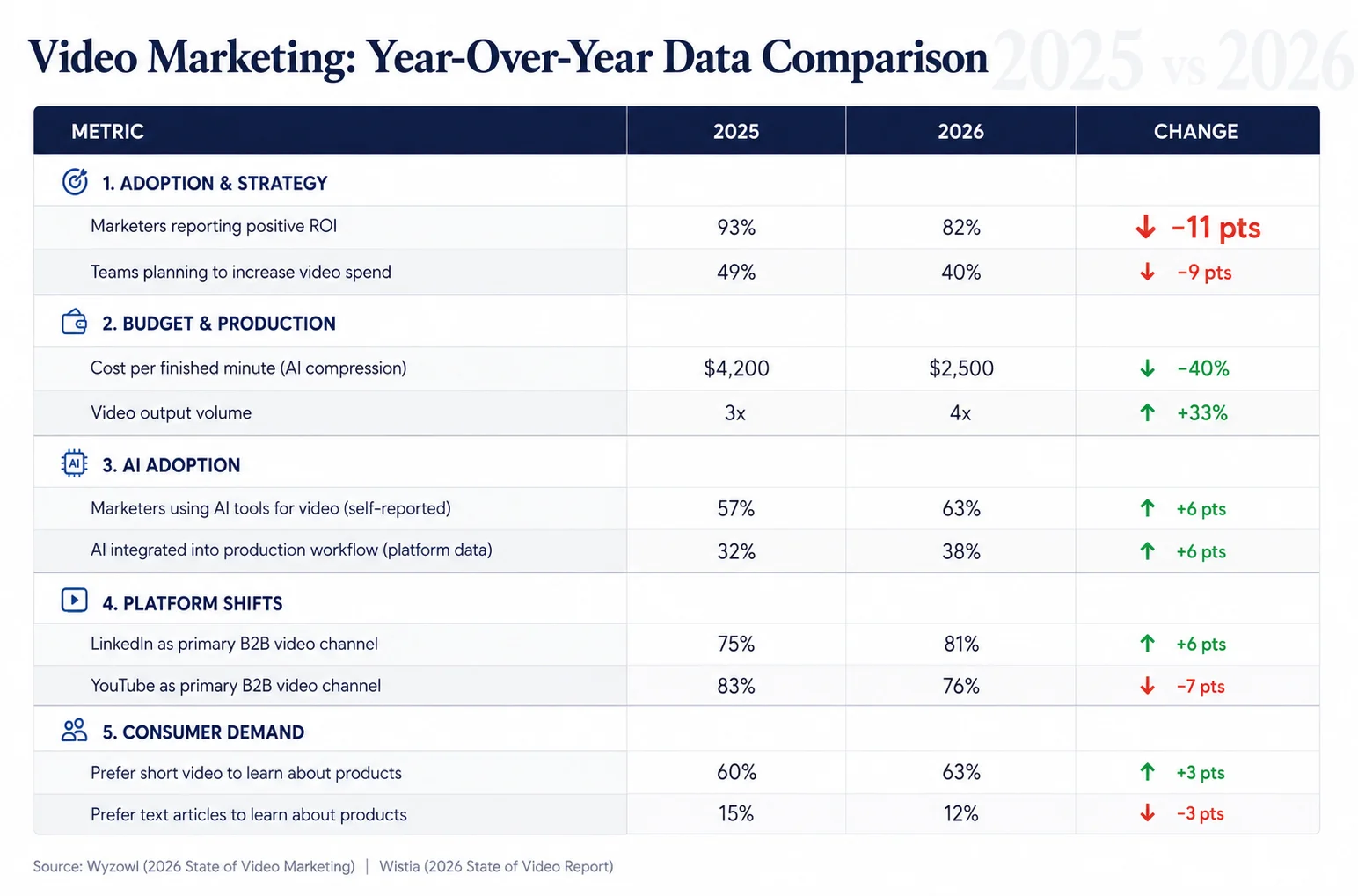
A clean comparison of the key metrics, same sources year over year:
Adoption and strategy (Wyzowl)
- Businesses using video: 89% (2025) to 91% (2026). Slight recovery.
- Video as an important strategy: 95% (2025) to 93% (2026). Slight dip.
- ROI perception (positive): 93% (2025) to 82% (2026). Significant drop.
Budget and production (Wistia)
- Teams planning to increase spend: 49% (2025) to 40% (2026). Continued decline from 57% in 2023.
- Companies spending under $5,000 on production: roughly 40% in both years. Stable at the low end.
AI adoption
- Wyzowl (self-reported, broad definition): 51% (2025) to 63% (2026). Jump.
- Wistia (workflow integration, stricter definition): 41% (2025) to 38% (2026). Plateau.
Platform shifts (Wistia)
- LinkedIn as primary B2B channel: rose to 81%, overtaking YouTube at 76%.
- TikTok adoption by marketing teams: still under 25%, despite being the most video-forward consumer platform.
Consumer demand (Wyzowl)
- Want more video from brands: 84% (2026). Stable within historical range.
- Convinced to buy by video: 85% (2026). Stable.
- Prefer short video for product learning: 63% (2026). Dominant preference.
The pattern across every metric is the same. Consumer demand is stable and strong. Marketer confidence is softening. Budgets are tightening. AI is changing production economics but not yet changing creative strategy. The market has matured past the growth phase and entered the efficiency phase.
The Story the Roundups Are Not Telling You
Most video marketing statistics 2026 posts present the data as a case for doing more video. The data supports a different argument: do better video, and measure it properly.
The advantage in 2026 does not go to the team that produces the most video. It goes to the team that measures the most carefully.
The ROI drop is a measurement signal, not a failure signal. Teams tracking behavioral metrics (watch time, completion rate, conversion assists) instead of vanity metrics (views, likes) can still demonstrate clear returns.
The budget constraint is real and not temporary. Production costs will keep dropping. Volume will keep rising. The teams that win will invest in distribution and measurement, not creation alone.
If you run a WordPress site, the player you use determines what you track. View counts tell you almost nothing. Watch time, retention curves, and conversion events tell you whether your video is working. FluentPlayer is built around those metrics.
Video marketing works. The numbers still prove it. But the era where showing up with any video was enough is over. The data now rewards precision: what you make, where you put it, and how you track it.